
Henderson's Line-Up Blog


Reduced Resistance = Improved Fuel Economy

May 7th, 2010 by chris

The travel season is upon us, and once again, fuel prices have begun to climb. Though the cost of fuel has been fluctuating over the past couple of years, one thing you can count on is that it will rise when the flowers begin to bloom. And as you watch the numbers at the pump begin to climb, you may wonder what you can do to increase fuel economy and cut down on travel costs.

You’ve probably seen many articles that have been written about saving fuel, but they typically only touch on things most of us already know, like reducing highway speed and keeping your tires inflated to the right pressure. But there are many other things that can be done to improve fuel economy, and all of them have to do with reducing resistance, in one way or another.

Tire inflation pressure is indeed important, but so is the type of tire that you use on your coach. A tire that is wider than necessary typically produces a better ride, but it can also increase rolling resistance. A narrower, heavy-duty tire will ride rougher than its wide, cushy counterpart, so you’ll have to ask yourself if you’re willing to sacrifice a little bit of comfort for improved fuel economy. I should note here that a larger diameter tire won’t hurt fuel economy and may even help it, because a larger diameter tire turns fewer revolutions to cover the same distance, and engine rpm is lowered as a result.

Alignment is also extremely important. Incorrect alignment can cause a lot of resistance, requiring more throttle input to maintain a given speed. “Toe in” is the most critical setting of them all. Simply put, “toe in” means the front of the tires are “pigeon toed”. Obviously, too much toe will also cause your tires to wear more quickly.

It’s a good idea to have the alignment checked even when the coach is new, because the factory runs them through the alignment procedure pretty fast. And, when the coach is loaded for travel, especially an independent front suspension (IFS) coach, the alignment changes as the load changes. The only exception is self-leveling, air suspension coaches, where correct ride height is constantly maintained.

Straight axle coaches don’t change as much, but it’s still a good idea to check the alignment when loaded. One of the things we always recommend to our customers is that they ask the alignment shop, “When was the last time your equipment was calibrated?” At Henderson’s Line-Up, we measure our alignment jobs in hundredths of an inch. This is important, because if the toe in is just 1/8-inch off spec, that is equal to 28 feet of side scrub per mile—a lot of resistance and tire wear.

Some toe in is necessary when the vehicle is in the static (parked) position, because as the vehicle travels down the road the front wheels will open up, and actually be pointing straight (zero toe in). This happens because most motorhomes have what is known as a “positive scrub radius” on the front axle. On the P32 Chevy/Workhorse chassis, we’ve found that the front alignment needs to be toed in a full ¼ inch at the static setting. The typical alignment shop would think that’s nuts, but we experimented with it, and that’s how much they require to stay at zero toe-in in the dynamic (moving) position. Static settings are important, but I’m more concerned with what the vehicle is doing as it drives down the road.

A lot of RVers don’t know is that the rear axle, or axles, can also be out of alignment—and if that’s the case, this problem can increase resistance and tire wear, reduce fuel economy and cause handling issues. The axle may be askew or not installed properly from the factory—the end result being rear wheel steering.

Have you ever been following a vehicle that looks like it’s going down the road a little sideways? We call that “dog tracking.” The driver keeps the wheel turned to compensate for it, and creates scrub. At the same time, aerodynamic efficiency is reduced, because more surface area is exposed to wind resistance.

Dog tracking isn’t particularly common; I’d say we have to do a rear wheel alignment on one out of 20 coaches, and most of the time they’re off by just a little bit. We perform what is called “thrust angle alignment”, where we put gauges on all four wheels, and set the front wheels in relation to the rear axle. How much affect rear axle misalignment has on the coach depends on the wheelbase; for example, if the rear axle is off by 1/8-inch, the difference in angle will be magnified more over 200 inches than 100 inches, for example.

Trailers can also be affected by incorrect axle alignment. When align a trailer, we line up the axles to the hitch point, whether that’s the hitch ball (travel trailer) or king pin (fifth wheel). That way, the trailer tracks better, and there’s no scrub—so now you’re saving fuel and the trailer tires will last longer.

Now while we’ve been talking about resistance with regard to alignment, there are other factors that increase resistance and adversely affect fuel economy. For example, improving the airflow into and out of the engine is reducing resistance, and usually results in some fuel economy improvement.

There is no “magic bullet” for improving fuel economy in your rig—but a combination of the correct tires and inflation pressure, front/rear alignment, driving style and engine enhancements can add up to substantial savings each year.

Trucks, Truck Campers and Good Handling

April 22nd, 2010 by chris

With the volatile fuel prices we’ve been experiencing over the last couple of years, along with a floundering economy, many RVers have been turning their attention to pick-up trucks and campers rather than large motorhomes. Campers are a great alternative, as they are comparatively light weight, maneuverable, and still allow you to tow a boat or trailer. However, trucks that haul a camper, pull a trailer or just carry heavy loads from time to time could benefit from some well-conceived suspension modifications.

Using air bags, such as those offered by Air Lift, Firestone and Pacbrake are a great start, but even with these in place, handling is usually far from ideal. When a customer comes into our shop, the first thing we’ll start with is a Road Performance Assessment (RPA) to determine the extent of the truck’s handling issues. Trucks that carry campers often suffer from what we call “tail wagging the dog”. Also common in motorhomes with large rear overhangs, the problem is characterized by a “wagging” sensation that comes from the rear after steering input. The overhang creates leverage on the rear axle that causes it to move from side to side whenever the steering wheel is moved back and forth. This truck was fitted with a short box camper that also had significant rear overhang, and it was causing the same type of instability.

Our Trac Bars are a perfect solution to this problem. Just five part numbers fit the bulk of full-size trucks on the market today, the primary difference being whether the truck has an open (“C channel”) or closed (“Box”) frame. Like the Trac Bars that we use for motorhome applications, these Trac Bars bolt on to the frame on one side, and clamp to the axle on the other, which positively locates the axle and prevents lateral movement. No drilling or welding is required, and the install typically takes about an hour. The bar provides a noticeable difference in steering response and predictability. Here is a picture of our SS625 Trac Bar installed on a late model GMC 1500 pick-up:

If you have already got airbags on your truck, you’ve probably noticed that they generate quite a bit of bounce when driving into or out of a driveway, especially at an angle. Bounce from side-to-side several times before coming to rest is fairly typical.

To solve this issue, we have a product called a Motion Control Unit (MCU) that we originally started using on air bag suspension motorhomes. The MCU acts like a baffle that slows the flow of air into and out of the bag, so instead of it rebounding like a basketball, it creates a much smoother and gradual response that prevents bounce and rocking. MCU’s are available in varying sizes, but for pickups, we typically fit these comparatively small air bags with our #3 MCU’s, which are about the diameter of a cigarette and are about three inches long. Installation is simple: Just cut the airline and splice the MCU in place. Here is the MCU installed, visible just above the air bag:

These two simple modifications will make a marked improvement in handling, ride and stability when doing any kind of towing or hauling. It should be pointed out here that some trucks don’t come equipped with a rear stabilizer bar, and for those that do, it is often inadequate for a top-heavy load like a truck camper. We carry Roadmaster anti-sway bars that are considerably thicker than stock stabilizer bars, and bolt right into place in an hour or less. Below is a photo of a 2006 Dodge 2500 HD with air bags, our SS725 Trac Bar and Roadmaster Anti-Sway Bar. What a difference!

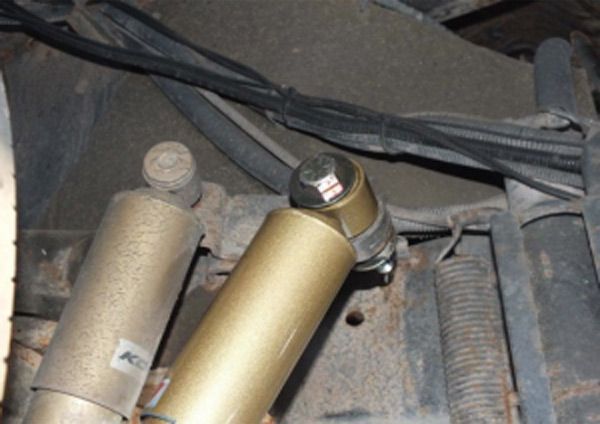
Finally, the stock shock absorbers are usually barely adequate when the truck is unloaded, not to mention when it is carrying a heavy load like a camper. Henderson’s Line-Up offers Bilstein and Koni FSD (Frequency Selective Damper) shock absorbers that are better at controlling load, and provide a better ride as well.

If you are unhappy with the ride and handling you are experiencing with your truck, give us a call. Whether you own a Chevy, Dodge, Ford, Toyota Tundra or Nissan Titan, we can restore driving confidence and fun to your pickup.

Welcome to our all-new website and blog

March 10th, 2010 by chris

Well, the big day has finally arrived. For years, we pondered a new website–one that was user-friendly, easy to navigate and informative, with an online store where our customers could purchase our SuperSteer products or any other fine products we sell. Needless to say, it was easier said than done–but we finally got our wish.

There are many great features about the site that we would like to tell you about. First, the online store. When you click on Products, it will take you directly to the store, which is categorized depending on whether you drive an RV or own a truck. If you are looking for something specific, or can’t see what you’re looking for, simply go to the search bar and type it in.  This section of the site is still a work in progress to some degree, so if you don’t find what you’re looking for, please feel free to call us and we’ll be glad to help you.

Our service menu covers all the services we provide our customers at Henderson’s Line-Up, so if you have any questions about what we can do, please check this section out.

Education is a section we’re quite proud of. It contains many articles we’ve written on a variety of subjects that our customers ask us about. Simply click on the title, and it will take you to a detailed article on the subject at hand. Under RV shows, you’ll find a schedule of all the places we’ll be this summer, so you can catch up with us at any one of the many rallys that we attend each year. As many of you know, we provide complete sales and installation services at many of the events we attend, so be sure and call us to schedule an appointment if you would like us to work on your coach, truck or trailer.

The “Latest News” window on the home page is where you’ll quickly find anything newsworthy with regard to Henderson’s Line-Up or SuperSteer. It could be new product updates, events, special deals, etc.–so be sure to check it out anytime you visit our site.

Last but not least, there’s this new blog. We’ll be posting technical articles, information on new products, news about particular chassis problems, etc. We’ll begin categorizing them so you can find the subject you’re looking for, and you’ll be able to post your replies and questions. Our intention is to keep this blog a dynamic part of the site–something that helps our customers and grows because of them. Please check back regularly to see what’s new–eventually we’ll have an RSS feed that you can subscribe to get Henderson’s Line-Up and SuperSteer news immediately.

Thank you for visiting our site. If you have any comments or questions, please let us know. We are looking forward to serving you.

Since 1961

Jesus said to him, "I am the way, and the truth, and the life; no one comes to the Father but through Me."
John 14:6

Verse of the Day